The Netherlands is smaller than West Virginia and exports more food by value than almost any country on earth. That single fact explains why so much of the science behind growing crops indoors was worked out in Dutch greenhouses and Dutch research institutes. Vertical farming is the most eye-catching expression of that tradition, and also the one most likely to be oversold. It deserves a clear-eyed look.
What vertical farming actually is
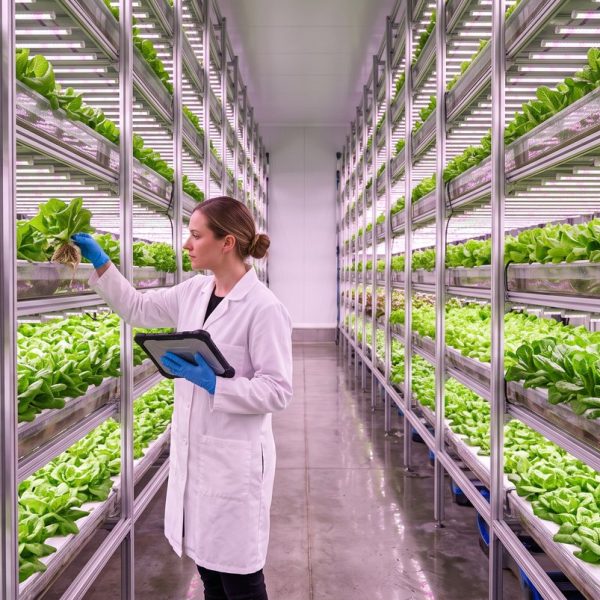
Stack the growing surface. Instead of one hectare of soil under the sky, you build shelves, ten or fifteen layers high, inside an insulated building. Each layer carries a shallow tray of roots fed by a nutrient solution, lit by LED arrays tuned to the wavelengths plants actually use. Temperature, humidity, carbon dioxide and light hours are all set by software.
No soil is involved in most systems. Hydroponic beds circulate water past the roots, aeroponic systems mist them, and both recycle what the plants do not absorb. Because nothing evaporates into a field and nothing drains away, water use falls to a small fraction of open-field farming for the same yield. That closed-loop logic is the heart of the vertical farming concept as it has developed since the early 2000s.
Why the Dutch got there first
Necessity. A country with little land, a dense population and a long history of reclaiming ground from the sea learned to treat space as its scarcest input. Wageningen University became the global centre for protected-crop research, and the greenhouse belt around Westland turned horticulture into an engineering discipline decades before anyone said the words vertical farm.
The knowledge that migrated indoors came from those greenhouses: how to dose nutrients precisely, how to manage humidity to prevent fungal disease, how to use predatory insects instead of pesticides, how to squeeze more kilograms out of each square metre every year. Dutch researchers publish this work continuously, and organisations such as the UN Food and Agriculture Organization now treat controlled-environment agriculture as a serious component of food security planning rather than a novelty.
What it genuinely does well
Yield per square metre is extraordinary. A vertical farm can produce leafy greens twenty to thirty times faster per unit of floor area than a field, because it harvests continuously all year with no seasons, no frost and no drought. Crops grow within a few kilometres of the supermarket, so a lettuce picked in the morning is on a shelf by lunchtime instead of spending five days in a refrigerated lorry.
Pesticide use drops to near zero in a sealed building. Water use falls by ninety percent or more. Land pressure eases, which matters most in dense cities and in countries importing nearly everything they eat. Singapore, the Gulf states and Japan have all invested for exactly that reason.
The problem nobody can engineer away
Light is not free. In a field, the sun does the work. Indoors, every photon comes from an LED, and LEDs run on electricity. That single line dominates the cost structure, and it is why the sector has been brutal to its investors. Several high-profile vertical farming companies collapsed when energy prices rose and the arithmetic stopped working.
Dutch vertical farming expertise travels widely, and much of what makes it work sits in agronomic detail rather than headline figures. Those details are where machine translation quietly loses precision, turning a specification into an approximation. These scientific translation services are built around closing that gap.
It also constrains the menu. Lettuce, herbs, microgreens and strawberries have a high value per kilogram and a low light requirement, so they pencil out. Wheat, rice, maize and potatoes do not, and probably never will. Vertical farms are not going to feed the world's calories. They are going to supply its salad, and that is a smaller ambition than the sector's press releases once implied.
Where the science is heading
Cheaper and more efficient LEDs, better light recipes tuned per crop and per growth stage, and heat recovery from the lighting itself. Powering farms on renewables changes the equation completely, since the energy cost is the whole argument. Breeding programmes are producing cultivars specifically for indoor conditions rather than adapting field varieties, which is a slow but genuinely important shift.
There is also a household-scale version of the same thinking. Anyone growing anything at home already knows that inputs matter more than space, and the same nutrient-cycle logic applies whether you run a warehouse or a windowsill. If you want a low-tech version of a closed loop, composting at home is where most people start.
Reading the research
Much of the best material on Dutch protected agriculture is published in Dutch first and English second, and technical accuracy in that translation matters more than it sounds. A mistranslated dosing table is not a stylistic problem. PoliLingua's overview of the Germanic language family to which Dutch belongs is a useful primer on why these languages look deceptively close to English and trip up casual translation.
Vertical farming is not a revolution and it is not a fraud. It is a specialised, energy-hungry tool that is superb at a narrow set of jobs. The Dutch, characteristically, seem to have understood that before anyone else.